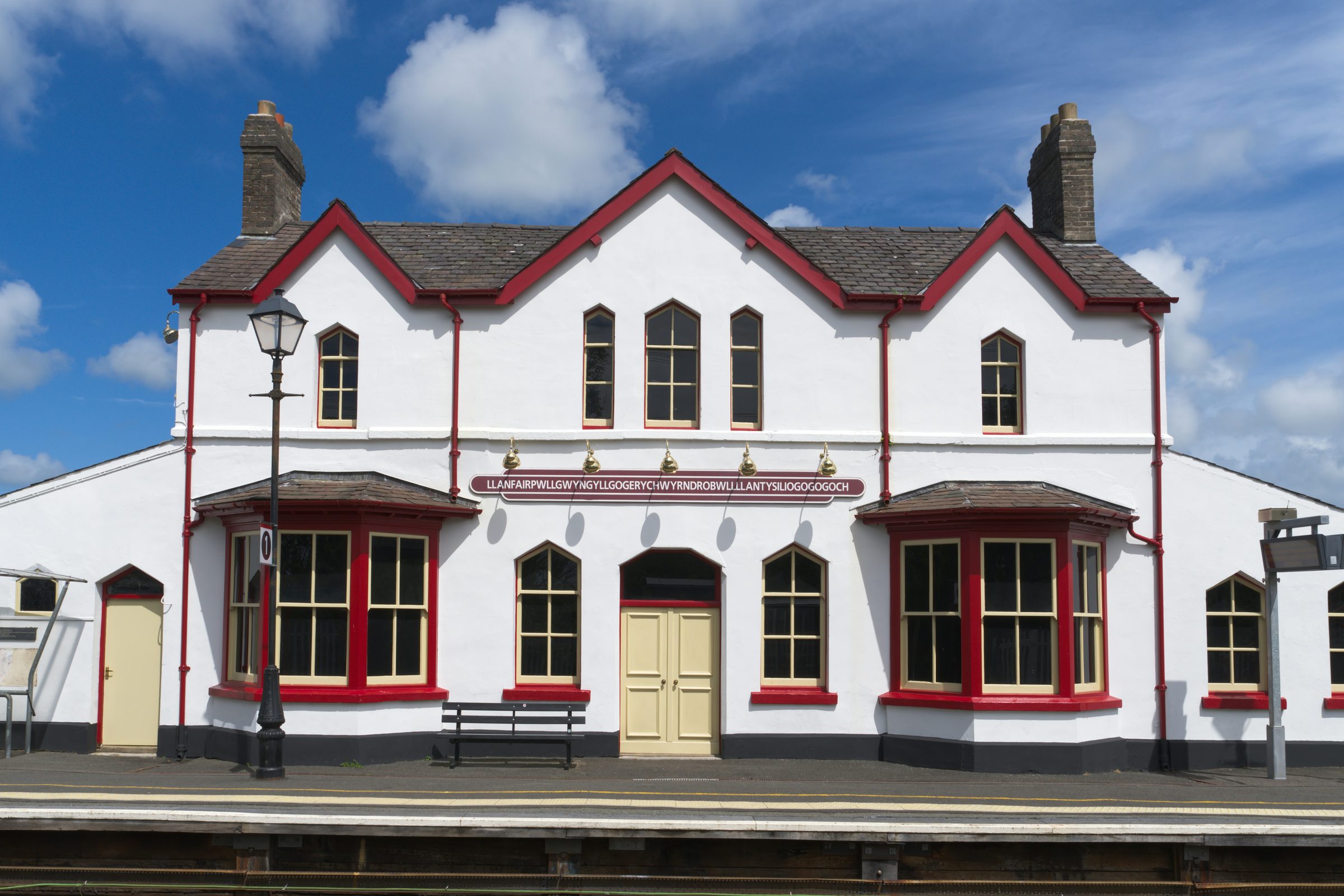
Say it with me: Llanfairpwllgwyngyllgogerychwyrndrobwllllantysiliogogogoch. Locals just say Llanfairpwll, or Llanfair PG, and the station's official name is the short one. About 2,900 people live here, and in 2011, 71% of residents could speak Welsh. Most visitors come for a photo with the sign, but the village has a lot more to it than that.
The name, and the stunt behind it
The original medieval township was Pwllgwyngyll, “the pool of the white hazels”, first written down as “Piwllgunyl” in the 1250s. By the mid 16th century the parish was Llanfair y Pwllgwyngyll, St Mary's church of the pool of the white hazels.
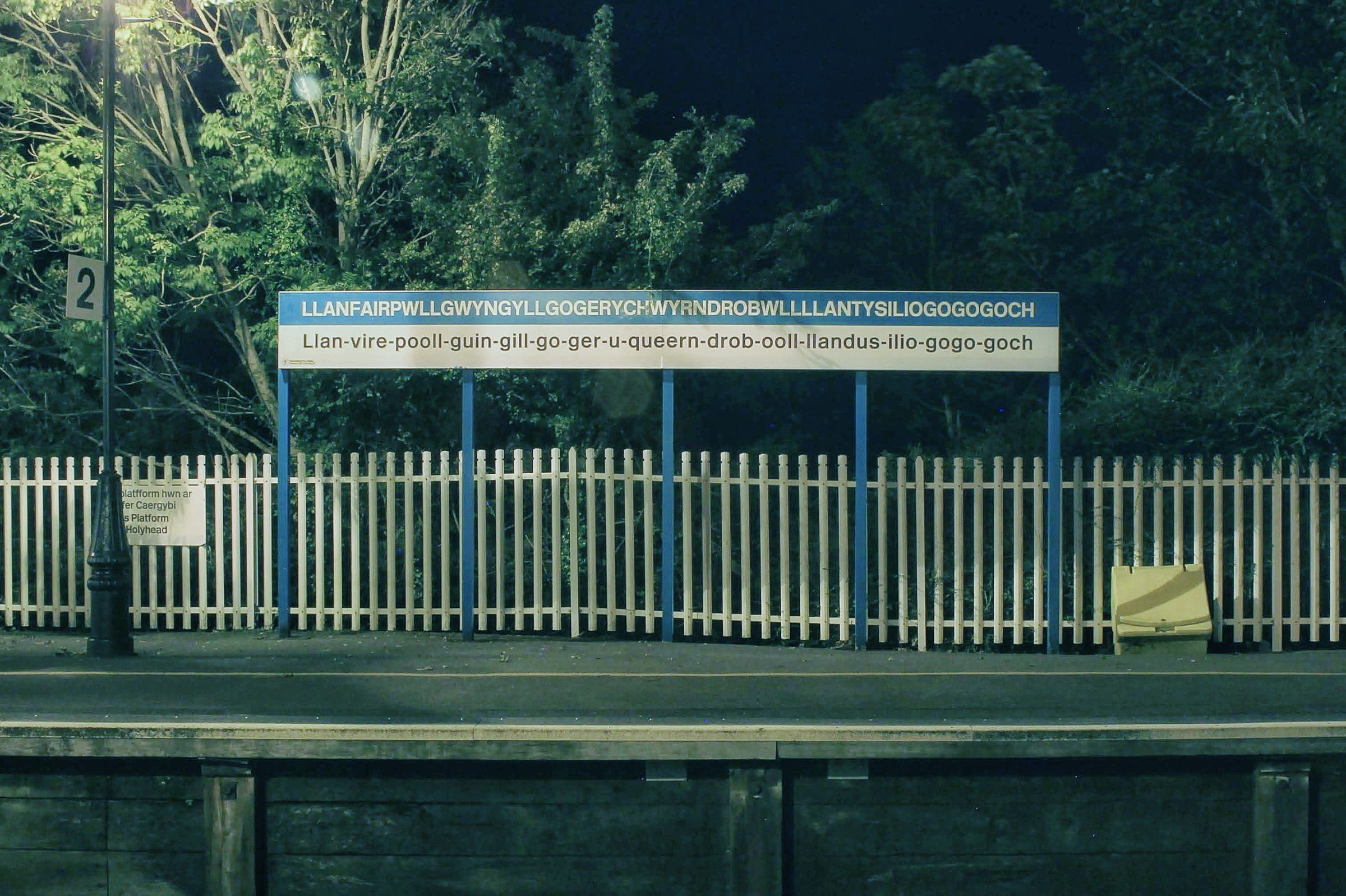
Then came the railway. The line from here to Holyhead opened on 1 August 1848, with the village as a temporary terminus, and passengers carried on across the Menai by road. When the Britannia Bridge opened in March 1850, trains could run straight through, and the story goes that the village came up with a fix to make people stop: stretch its name into the longest in Britain.
The story usually told is that the long name was coined in 1869 by a local tailor. Sir John Morris-Jones kept the tailor's identity secret and took it to his grave. The truth may be murkier, though, as there are hints that longer versions of the name were already in use before then.
What it means: St Mary's church in the hollow of the white hazels, near the fierce whirlpool, and the church of St Tysilio of the red cave. The whirlpool is the Swellies in the Menai Strait, and St Tysilio's is the little church on Church Island. Locals say the “gogogoch” at the end was inspired by Ynys Gorad Goch, the little fish-trap island in the Strait between the two bridges.
It's 58 characters long, but only 51 letters in Welsh, because “ll” and “ch” each count as a single letter.

The station closed in 1966, then reopened in 1970 as a temporary terminus while the fire-damaged Britannia Bridge was repaired. It reopened for good in 1973, and trains still stop here every day. Don't miss the bus shelter on Ffordd Penmynydd either, where signwriter Tomos Jones has hand-painted all 58 letters.
How the village got its famous name is on Discover Anglesey.
Name-dropping
- In 2020 scientists named a new species of soil bacterium found in the parish Myxococcus llanfairpwllgwyngyllgogerychwyrndrobwllllantysiliogogogochensis.
- Crossword setter Roger Squires used the full name in a cryptic crossword in July 1979, and it holds the Guinness World Record as the longest word ever used in one.
- Super Furry Animals named their 1995 debut EP after the village.
Britain's first Women's Institute
The WI started in Canada in 1897, but its first branch in Britain met right here, on 16 September 1915. Colonel Stapleton-Cotton and his wife Jane had invited Canadian Madge Watt to talk to local women about wartime food production, and the branch was founded at a cottage in the village.
The branch later moved into the hall that still stands today. It's a simple corrugated-iron building joined to the old toll house, which dates from about 1823, on the Holyhead road. The WI spread fast from here and is now one of Britain's best-known women's organisations. The hall is also headquarters of the Anglesey Federation of WIs.
The Marquess of Anglesey's Column (Tŵr Marcwis)
On a rocky outcrop that was probably a hillfort long ago stands a 27-metre Doric column. It honours Henry Paget, who was second in command to Wellington at Waterloo. Near the end of the battle, a shot shattered his right leg. The story goes that he said, “By God, sir, I've lost my leg!” and Wellington replied, “By God, sir, so you have!” The leg was amputated and buried at Waterloo, and his articulated wooden leg is on display at Plas Newydd, his home nearby.
Local people raised the money for the column, designed by Thomas Harrison and built from Moelfre stone, and it was finished in 1817. After the Marquess died in 1854, a statue of him was added to the top in 1860.
Inside, a spiral staircase of 115 steps climbs to the viewing platform. From there you can see across the island one way, and to Eryri and the Menai Strait the other. The column is part of the GeoMôn UNESCO Global Geopark, which covers the whole island, and there's a café at the bottom. Check angleseycolumn.com for opening days and prices before you go.
A few more local tidbits
- The old village up the hill is Pentre Uchaf, the "upper village". The newer part that grew up around the station is Pentre Isaf, the "lower village".
- Painter Sir Kyffin Williams lived and worked at Pwllfanogl, near the village, from 1974 until his death in 2006.
A few tips from a local
- Get your sign photo on the station platform. The sign even spells out the pronunciation for English speakers.
- Wear sensible shoes for the woodland path up to the Column.
- Pair the Column with Plas Newydd to get the whole story of the Marquess and his leg.
Photo credits
- Llanfairpwll railway station building, with the village's full name on a sign above the doors. Photo: Pix Tresa / Unsplash (Unsplash Licence).
- Llanfairpwll station sign at night, with the full name and its pronunciation. Photo: Rhoderzzz / Wikimedia Commons (CC BY-SA 4.0), cropped.
- The full 58-letter name of Llanfairpwllgwyngyll on a curved sign along a brick wall. Photo: Rémih / Wikimedia Commons (CC BY-SA 4.0), cropped.