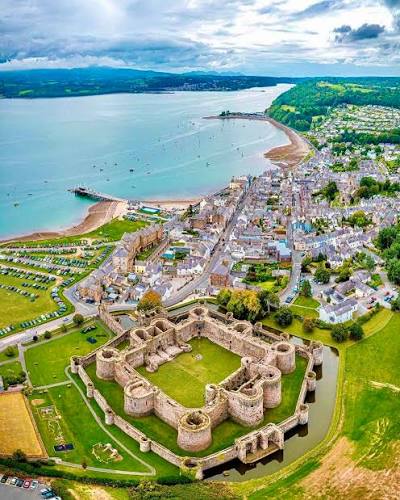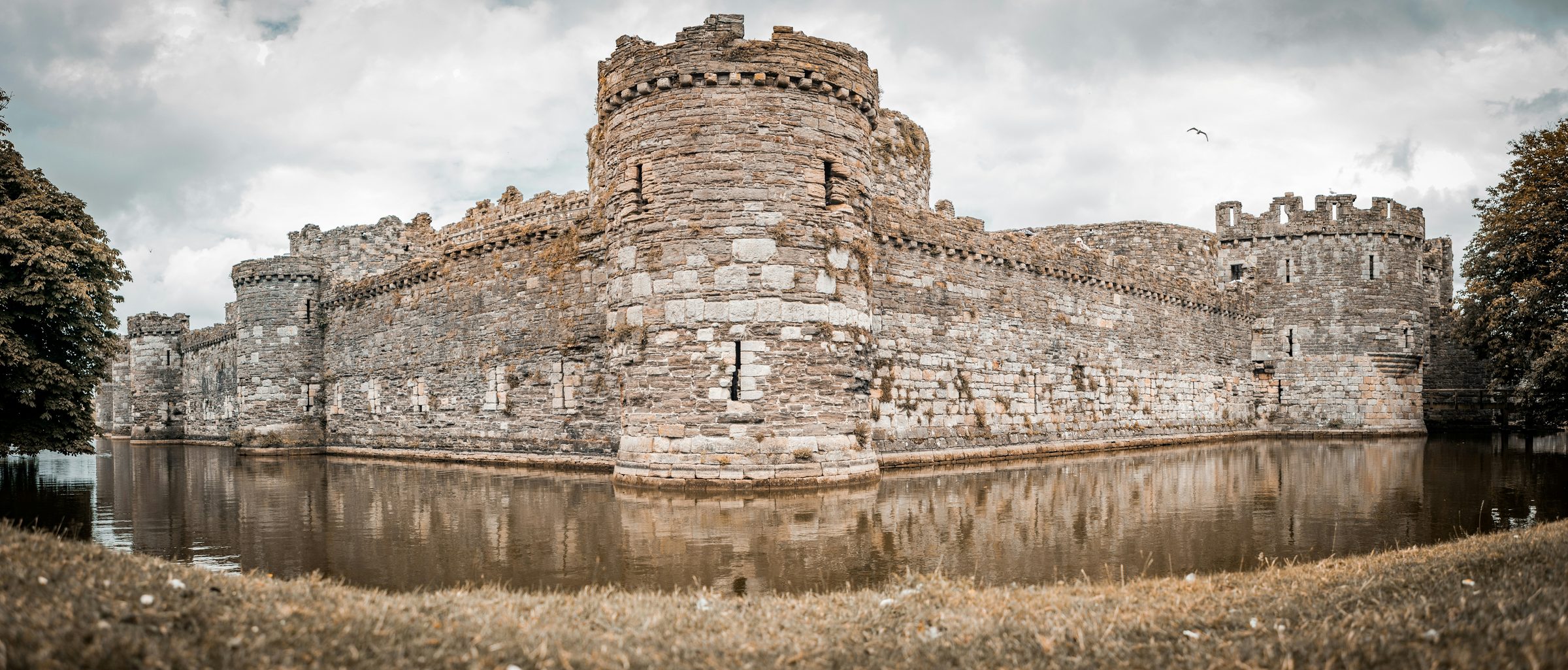
Cadw calls Beaumaris the greatest castle never built, and once you've walked round it you'll see why. It's squat, perfectly symmetrical, sitting in its own moat at the end of Castle Street, and it was never finished. Castell Biwmares, we call it in Welsh. It's at its best on a quiet winter morning, when the moat is still and the mountains across the Strait are dusted with snow.
A beautiful marsh
The name comes from the Norman French beau mareys, the beautiful marsh, because that's exactly what this spot was before Edward I arrived. The flat ground gave his builders a blank canvas, and they used every inch of it.
But there's a darker side that locals don't forget. A mile up the road stood Llanfaes, a thriving Welsh port that had grown up under Llywelyn the Great, with his court nearby and a Franciscan friary he founded. Edward wanted his new English town right here, so Llanfaes had to go. His troops started pulling it down as soon as they arrived in 1295. The townspeople petitioned the king that they could no longer buy or sell, and that ships weren't allowed to land in their harbour. It made no difference. By the time Edward died in 1307, all that stood at Llanfaes was a windmill, the church and the friary. Many of its families were moved 13 miles across the island to a brand new town built for them: Newborough.
Meanwhile Beaumaris got its royal charter in 1296, and by 1305 it had 132 burgage plots, the biggest borough in north Wales. Later it became the county town of Anglesey.
A building site frozen in time
Work started in the summer of 1295, overseen by Master James of St George, and the scale was staggering. That first summer there were around 1,800 labourers on site, alongside about 450 masons and 375 quarrymen, costing around £270 a week in wages. The money ran short so fast that workers were paid in leather tokens. Over the first winter the middle of the castle was full of huts for the workforce.
The plan was four rings of defence: the moat, the outer wall, the outer ward and the towering inner wall. Then Edward's wars in Scotland swallowed his money. Work slowed in 1296, stopped altogether by 1300, started again in 1306 over fears of a Scottish invasion, and finally fizzled out by around 1330. By then about £15,000 had been spent, a colossal sum, and the castle still wasn't finished. The six great towers and the south gatehouse of the inner ward never reached their full height. That's why it looks so low and broad today.
The story of the castle is on Discover Anglesey.
After the builders left
- 1403 to 1405: Owain Glyndŵr's rebels besieged and took the castle, before royal forces won it back.
- 1593: William Davies, a Welsh Catholic priest imprisoned here, was executed at the castle on 27 July.
- Over the following centuries it slowly fell into disrepair.
- The Civil War: Thomas, Viscount Bulkeley held it for Charles I and is said to have spent £3,000 repairing it. It was surrendered to Parliament in June 1646, and briefly retaken by Royalists during Anglesey's 1648 uprising. It was later stripped of its lead and roofs.
- 1807: Viscount Bulkeley bought it from the Crown for £735 and made it part of the park around Baron Hill, the family seat above the town.
- 1832: a young Princess Victoria came to a Royal Eisteddfod held in the inner ward.
- 1925: the castle passed into state care. The ivy came off, the stonework was repaired and the moat was dug out and filled again. Today Cadw looks after it, and it's part of a UNESCO World Heritage Site.
What to look out for
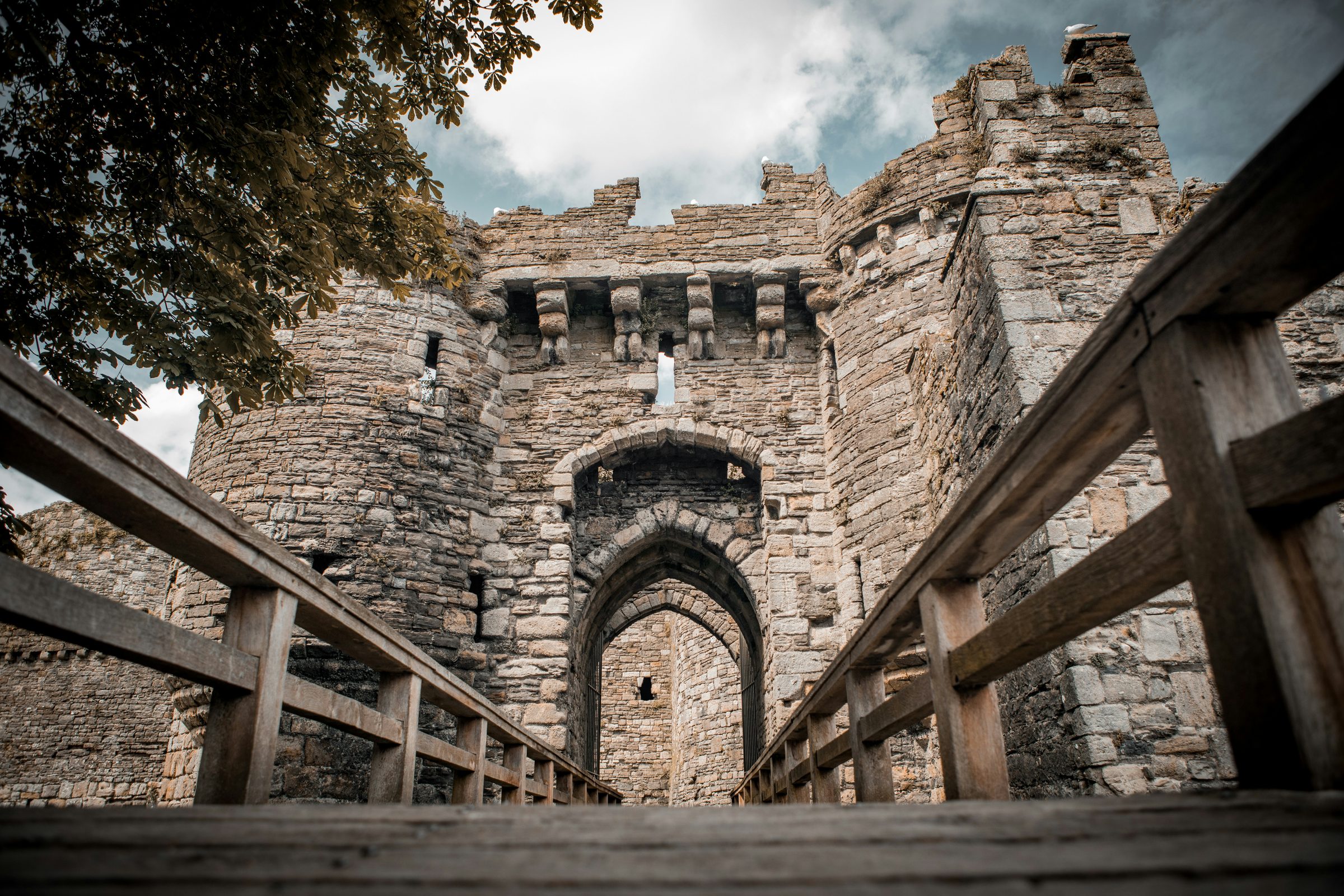
- The dock. Beside the main entrance, the Gate next the Sea, is the castle's own tidal dock, where ships could unload straight into the castle. The wall protecting it is known as the Gunners Walk. Look for the round tower in it, which once held a tidal mill, and the platform at the end, which may have carried a trebuchet.
- The gates that don't line up. The outer gate and the inner gatehouse are deliberately out of line. Anyone who broke in had to cross open ground, under fire from every side, to reach the next gate.
- Arrow loops everywhere. Between the arrow loops and the battlements, the outer walls gave defenders around 300 places to shoot from.
- The Llanfaes Gate. Walk round to the north side and you'll find a gatehouse that was barely started. It has survived much as the builders left it, more or less pointing at the town Edward destroyed.
- The chapel. Climb to the middle of the east wall for the chapel tower. It has a vaulted ceiling, five tall pointed windows and small side chambers. It's the most beautiful room in the castle.
- The wall passages. The inner walls are honeycombed with first-floor passages linking the towers, complete with latrines. Kids love them, but bring a torch for the darker stairs.
- The stone. Look closely at the lower walls and you'll spot greenish stone mixed in. It was only used before the 1298 pause, so it's a handy way of telling which bits went up first. Some of the limestone is thought to have come by boat from Penmon, just up the coast.
Little things locals know
- The inner walls stand about 36 feet (11 m) high, but they were meant to be far taller.
- J. M. W. Turner painted the castle in 1835.
- Some of its stone ended up in Beaumaris Gaol, built just up the road in 1829. Pair the castle with the gaol and the courthouse for a proper day of town history.
- The town around you still follows the street plan laid out in Edward's day, around Castle Street and Church Street. Stroll down Castle Street to the pier, which opened in 1846, for the classic view back over the Strait.
- The bottom rooms of the inner towers have no windows, and may have been used as prisons.
Planning your visit
Opening times
- 1 March to 30 June: 9.30am to 5pm
- 1 July to 31 August: 9.30am to 6pm
- 1 September to 31 October: 9.30am to 5pm
- 1 November to 28 February: 10am to 4pm
Last entry is 30 minutes before closing. It's closed 24, 25 and 26 December and 1 January, and can shut at short notice in extreme weather.
Tickets (1 September 2026 to 31 March 2027)
- Adult £10.40
- Senior (65+) £9.30
- Junior (5 to 17) or student £7.20
- Family (2 adults and up to 3 children) £33.30
- Family (1 adult and up to 3 children) £22.90
- Under 5s, Cadw members, and disabled visitors with a companion go free
- Book online and save 5%. There's also a £1 ticket for people on Universal Credit and other named benefits.
Getting there
The castle is at the end of Castle Street, Beaumaris, LL58 8AP (what3words plan.encloses.splash). Park in the main town car park opposite, which is the most direct way in, but watch for two-way traffic. Buses 53, 57 and 58 run from Bangor and stop about 100 metres away.
Photo credits
- The walls and towers of Beaumaris Castle reflected in its moat. Photo: Gabriel Kiener / Unsplash (Unsplash Licence).
- The gatehouse of Beaumaris Castle seen from the wooden bridge, looking up through the arched entrance. Photo: Gabriel Kiener / Unsplash (Unsplash Licence).